
Eternal value through temporal work.
Eternal value through temporal work.
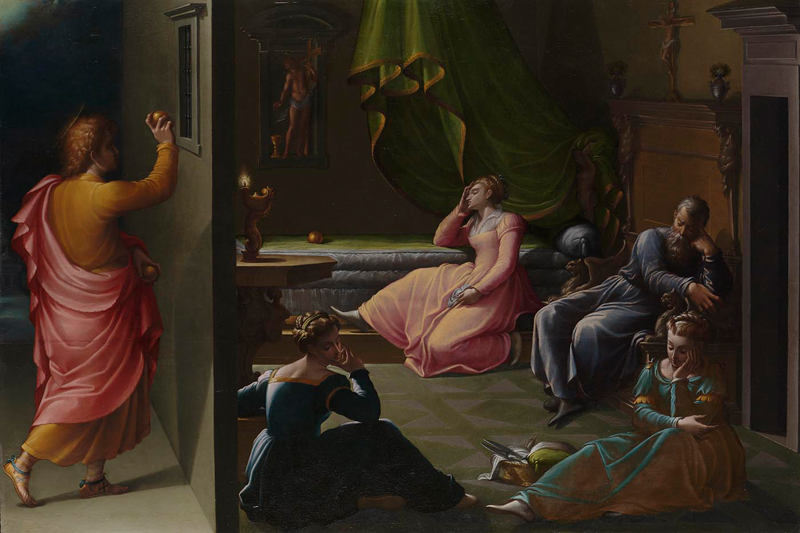
The Charity of St. Nicholas of Bari
Girolamo Macchietti, 1555
Each month, the Bank of Mercy gives $500 in cash to twelve stewards of mercy to bless others anonymously in God's name. Each steward is elected through a process analogous to jury duty and asked to pray over a single question: how can I use this to glorify God? As St. Nicholas did, they are encouraged to deliver it anonymously, so that no name may be praised and no hand seen, except God's.
"The goal is to create a living allegory of God's Mercy," says one of the founders. When someone receives unexpected mercy from a stranger, they encounter something that reason alone cannot explain. Hopefully causing them to look up.
The founders believe this experience helps people begin to understand the nature of the mercy God has shown us: that while we were still sinners, God came as Jesus and died so that we may live, freely, even though we did not deserve it. Understanding this is what transforms a heart of stone into a heart of flesh, and teaches the steward about laying up riches in heaven.
The founders consider the election mechanism the most important feature. "The jury duty mechanism creates two spiritual opportunities," they write, "to soften a hardened heart, and to give someone a taste of what God's Kingdom is like."
The Bank of Mercy launched in Louisville, Kentucky in March 2026 with twelve original stewards and is growing deliberately one steward at a time, in the spirit of the early church. "The temptation is to feel like one at a time is too slow," they say, "but that's Babel thinking."
"The problem with financial institutions today," the founders argue, "is that they aren't accountable to anything higher than their own continuation. They are headless." The Bank of Mercy is an attempt to restore the head, which they believe is Christ, who calls us to invert our relationship to money by giving it away, laying up riches in heaven. Jacques Ellul calls this "profaning Mammon."
They say this inversion is similar to the other inverted properties of God's Kingdom: the first will be last and the last will be first, the exalted will be humbled and the humbled will be exalted, strength in weakness, and ultimately, victory through defeat, where God uses the instrument of death as the ultimate symbol of life and victory over sin.
In that same spirit, the founders maintain personal anonymity, drawing on the scriptural principle: "He must increase, and I must decrease."

The Bank of Mercy is a 501(c)(3) nonprofit, not an FDIC-insured bank.